Neither format is universally better. The useful choice depends on whether you are storing an original, editing it, or sending a copy to a specific destination.
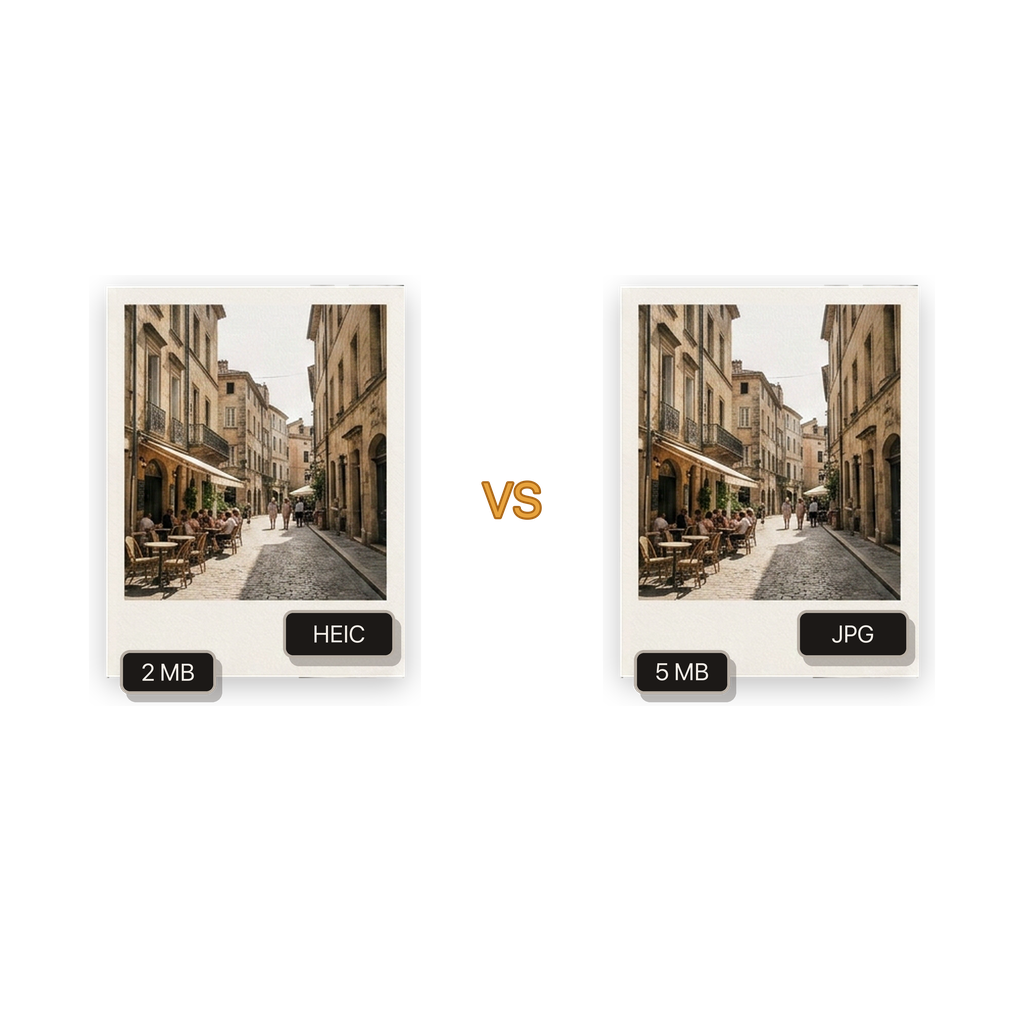
| Question | HEIC | JPEG |
|---|---|---|
| Storage | More efficient compression | Often a larger file at comparable visual quality |
| Compatibility | Built into current Apple operating systems; support varies by app and destination | Broad support across older and current systems |
| Typical iPhone role | Camera capture and original library | Compatible copy for sharing or delivery |
| Conversion advice | Keep the source when useful | Choose quality and resolution for the destination |
What does HEIC mean on an iPhone?
HEIC is a common filename extension for images stored using the High Efficiency Image File Format, or HEIF. Apple uses HEIF for photos because it offers more efficient compression than JPEG while preserving comparable visual quality.
Apple operating systems from iOS 11 and macOS High Sierra include HEIF support, although viewing and editing still depend on the device and app. A recipient, upload form, or older application may still expect JPEG instead.
When is JPEG the more practical choice?
JPEG is often the safer delivery format when a website explicitly lists JPG or JPEG, a business workflow uses older software, or a recipient reports that the HEIC file will not open.
Some Apple sharing methods can automatically provide a more compatible file to the recipient, but that behavior depends on the sharing route and receiving device. A deliberate conversion gives you control over the actual JPG output before you send it.
Does converting HEIC to JPEG reduce quality?
JPEG uses lossy compression, so creating a JPG involves an output-quality choice. A higher JPG quality generally preserves more visible detail but produces a larger file. Reducing the resolution can also remove pixel detail because the output contains fewer pixels.
Avoid describing the conversion as lossless. Keep the original HEIC when you may need the source later, then create a JPG configured for the destination.
Should you keep HEIC, JPEG, or both?
Keep HEIC as the source when it works well in your library and storage efficiency matters. Create JPEG copies for delivery, upload, or compatibility. This separates preservation from distribution instead of forcing one format to do both jobs.
When you need a compatible copy, Batch HEIC to JPG Converter can convert HEIC to JPG on your iPhone with quality, resolution, and location-metadata controls.
Source for iPhone format behavior: Apple Support: Using HEIF or HEVC media on Apple devices.
Common questions
Is HEIC the same as HEIF?
HEIF is the image-file format; HEIC is a filename extension commonly used for HEIF images captured by Apple devices.
Is JPEG the same as JPG?
Yes for practical use. JPG is the shortened three-letter filename extension for the JPEG image format.
Which format uses less storage?
HEIC generally provides more efficient compression than JPEG at comparable visual quality, which is why Apple uses it for High Efficiency capture.
Should I delete the HEIC after making a JPG?
Keep the HEIC if you value the source file or may need a different output later. Delete or archive files only according to your own storage workflow.
Can a JPG keep location metadata?
A JPG can contain location metadata. Batch HEIC to JPG Converter lets you choose whether that location information stays in the converted output.